
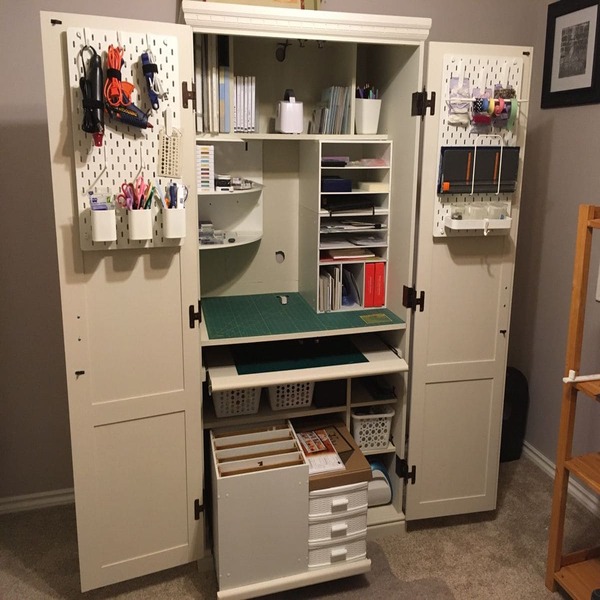
What Cabinet Organizing Systems Actually Reduce Decision Fatigue?
At The Organized Nest, we've seen how cabinet organizing systems reduce decision fatigue by giving every item a fixed, visible, and logical home. When you stop thinking about where something is or where it belongs, you free up mental energy for what actually matters. The most effective systems rely on three things: defined zones, consistent containers, and clear labels.

Key Takeaways:
Decision fatigue is a documented cognitive pattern where repeated choices deplete mental energy throughout the day.
Cabinet organizing works best when items are grouped by function, not by shape or size.
Consistent containers reduce visual noise and make restocking and retrieval automatic.
At The Organized Nest, a cabinet organizer can assess your actual usage habits before recommending any products or layouts.
Labeled systems last longer: when every household member knows where things belong, the system maintains itself with far less effort.
What Is Decision Fatigue and Why Do Cabinets Cause It?
Decision fatigue occurs when repeated decision-making reduces a person's ability to make good choices later in the day.
Disorganized cabinets force small decisions constantly. Where is the cutting board? Which shelf has the vitamins? Does this pan go here or there? Each micro-decision draws from the same mental reserve.
Researchers estimate that the average American adult makes roughly 35,000 decisions every day. Research published in the Journal of Health Psychology found that making repeated decisions depletes mental resources over time, a condition known as decision fatigue, which leads to impulsive choices, avoidance, or simply picking whatever requires the least thinking.
A well-built cabinet organizing system eliminates those micro-decisions entirely.
Which Cabinet Organizing Systems Work Best?
The most effective cabinet organizing systems share three traits: fixed zones, uniform containers, and visible access.
Zone-Based Organization
Zone-based cabinet organizing groups items by how and when they are used, not by category alone.
Examples:
A breakfast zone holds cereals, bowls, and mugs within reach of each other.
A baking zone consolidates measuring cups, mixing bowls, and ingredients on one shelf.
A medicine cabinet zone separates daily vitamins from first-aid supplies.
When a zone is established, retrieval becomes automatic. You stop searching and start reaching.
Uniform Containers
Mismatched containers create visual noise. Visual noise increases cognitive load.
Uniform bins, baskets, or drawer inserts do two things:
They make the cabinet easier to scan quickly.
They signal where items belong when putting them away.
A cabinet organizer will typically recommend containers only after measuring your cabinet dimensions and assessing what you actually store. Buying bins before that step often wastes money.
Vertical Space and Visibility
Most cabinets underuse vertical space. Stackable shelves, tiered risers, and pull-out drawers bring back-of-cabinet items into view. Items you cannot see are items you forget you own, which leads to duplicates and clutter.
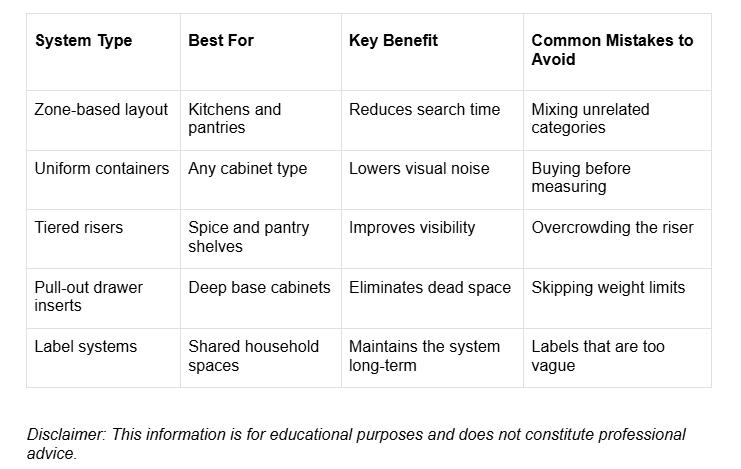
Cabinet Organizing System Comparison
Frequently Asked Questions
How do I start a cabinet organizing project without getting overwhelmed?
Start with one cabinet, not the whole kitchen. Empty it completely, clean the interior, and only return items that belong to that cabinet's zone. Repeat for each cabinet before purchasing any containers.
What products does a cabinet organizer typically recommend?
Recommendations depend on the cabinet size and contents. Common products include stackable shelf risers, pull-out bins, drawer dividers, lazy Susans, and uniform storage containers with labels.
How long does cabinet organizing take?
A single cabinet takes 30 to 90 minutes. A full kitchen typically requires a half-day to full-day session with a professional.

Get a Cabinet Organizer in Fort Worth
At The Organized Nest, our cabinet organizing services are designed around how your household actually functions. Every recommendation we make is based on your space, your habits, and your goals.
Call us at (817) 720-3505 or email [email protected] to request your consultation. The Organized Nest serves Fort Worth, Benbrook, Burleson, and nearby areas.